
Published
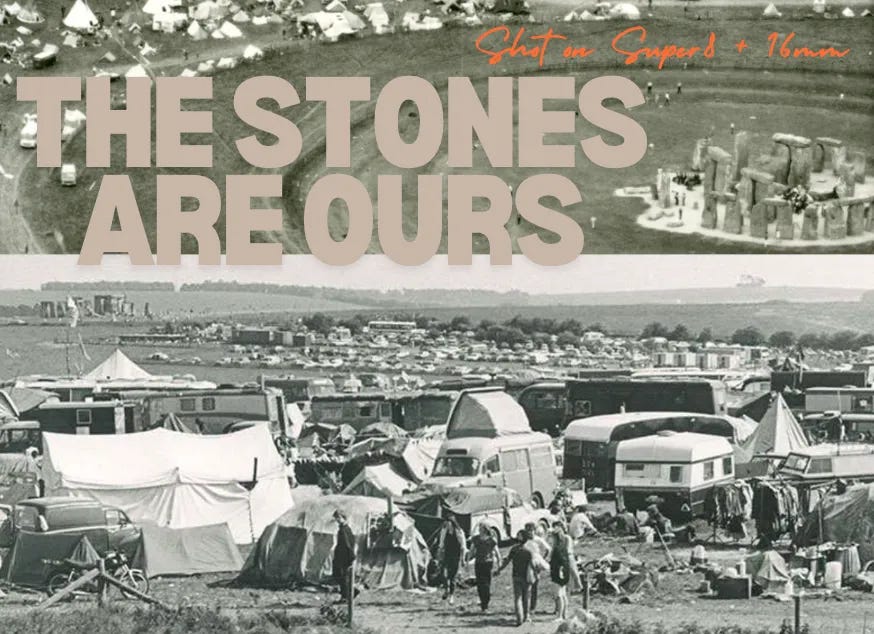
We’re absolutely thrilled to be involved with Guilia Franchi’s feature length debut, The Stones Are Ours, which will be built out of a tapestry of analogue archive material interwoven with contemporary footage shot on Super 8 and 16mm.
SAM: Can you outline the project for us?
GIULIA: We wanted to celebrate the 50th anniversary of the Stonehenge Free Festivals, which is this year. And then it’s also looking back on the history of the festivals and the legacy that the founding group is leaving behind. From 1974 until 1985, and then where everyone is now.
SAM: Why is it that you’ve decided to shoot on film?
GIULIA: I really wanted it to be shot as if it was being made at the time. A lot of the archive stuff that we were working with from the set, the seventies, eighties, when the festival was on, working with great footage that was shot by people who were in the peace convoy. I thought it would be interesting to shoot it in the same way that they would have, but I have a slightly kind of more modern twist on it. So we chose to shoot with a really ultra wide lens
SAM: How did the project start? Where did you find the archive material?
GIULIA: I think basically I found the story last winter, and I was researching it for couple of months. I found a lot of stuff through that, but I didn’t really find a lot of the really rich stuff until I started interviewing people. The network just slowly grew and grew. That was when I launched it through your collaboration and the Stone Clubs collaboration, that poster, that was when it all took off. People started reaching out to me and sending me stuff.

GIULIA: So the filmmaker, Chris Waite, he was one of the main people in that initial circle that was allowed to shoot films. They were trusted insiders, but obviously around the time everyone was really sceptical of cameras. There were any photo journalists there.
SAM: I saw you were shooting at Glastonbury, and you’re shooting at Stonehenge at Solstice recently. Shooting on film really does make you stand out. Were people or excited when they saw that you were shooting with the old formats?
GIULIA: At Solstice, it’s funny because there were a lot of other indie filmmakers, actually there were probably two or three other the crews that are also shooting on film, which is nice. I think it makes people a little bit more excited by the project. And then I shot a little bit of Super 8 at Glastonbury.
SAM: Are there any influences, any filmmakers that have inspired you?
GIULIA: Yeah, I really love hybrid docs. There’s a filmmaker called Edward Lovelace and he works a lot with film and does really beautiful drama hybrids. And who else do I love? I worry about veering away from my initial vision. I get influenced quite easily. I really love the Right to Roam documentary.
SAM: That’s Joya Berrow and Lucy Jane?
GIULIA: Yeah! I really loved their work. I strangely ended up meeting Deadbeat Films at Solstice. They’ve worked with Joya and Lucy before. I met them at sundown because I was handing out flyers for this project.Their work has inspired me since I started making films, so it wasn’t a sort of dream to bump into them very serendipitously at sundown.

SAM: So what’s the timeline of the film?
GIULIA: It’s a bit ambitious, since we’re still applying for funding. I would really love to be able to screen something a year from now, because next year is the anniversary of Wally Hope’s death. We have so much archive footage to work with. We’re trying to ensure that we can get the right licences.